Museum of Pharmacy, Wroclaw Medical University
Muzeum Farmacji Uniwersytetu Medycznego we Wrocławiu
90 m from the Market Square in Wroclaw See museums near the Market Square in Wroclaw
- Tours in English: The museum does not provide an English-speaking guide.
- The museum publishes an English version of its visitors page, with the same entry times and rules as the Polish one.
- Entry is on the hour, the first entry shortly after opening.
- Visitors go round on their own; a self-guided visit needs no booking.
- Coats, backpacks and suitcases can be left at the museum, which takes no responsibility for them.
- No steps at the entrance to the main hall, one public lift and an accessible toilet on the ground floor; assistance and guide dogs are admitted.
Location
What to expect
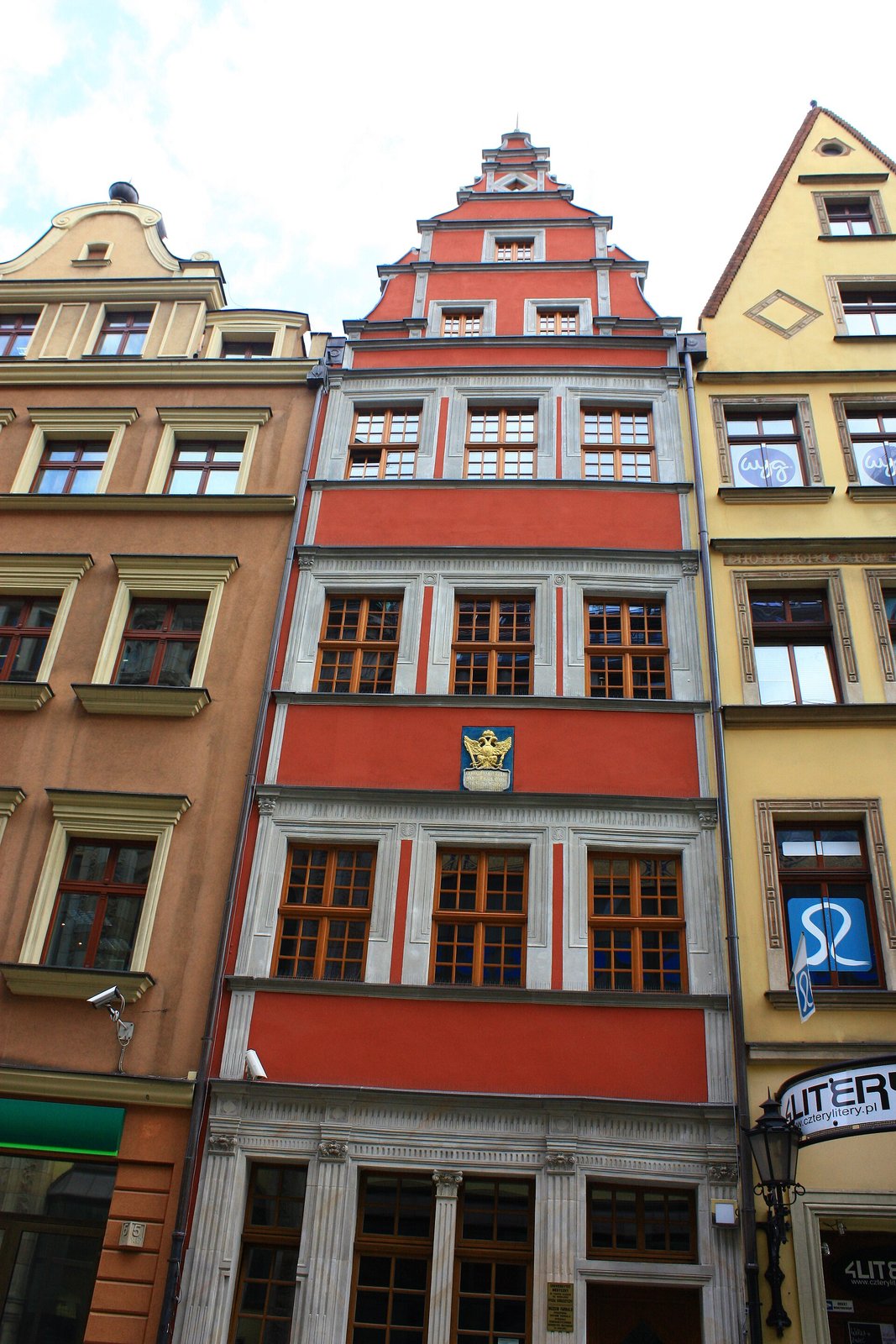
The Pharmacy Museum in Wroclaw is a former pharmacy turned into a science museum: the house at Kurzy Targ 4, known today as the Dom Śląskiego Aptekarza (House of the Silesian Apothecary), where a unit of the Faculty of Pharmacy of the Medical University presents the history of science, medicine, pharmacy and pharmacies.
You visit it floor by floor. According to the museum, the route begins in the cellar, in the alchemist’s workshop, leads through the Renaissance pharmacy interior on the ground floor and ends on the second floor. Gazeta Wrocławska (25 May 2025) also describes what lies above: natural medicines and old tools on the first floor, measuring apparatus and synthetic drugs on the second.
You go round on your own, individually or in a group, and there is no need to book; a large group (e.g. 50 people) has to split into smaller ones. Entry is on the hour, so the visit has a fixed rhythm and is worth planning, and admission is free.
Visitors rate the museum highly: on Google Maps it has 4.7 out of 5 from 366 reviews, and on Facebook 94% of 18 reviewers recommend it (read on 4 November 2026).
Who it suits: anyone curious about the history of medicine, pharmacy and science, and anyone drawn by an alchemist’s workshop in a cellar and an old pharmacy. The entrance to the main hall has no steps and the building has a lift, so the route also suits visitors with reduced mobility.
Who should skip it: a family looking for a hands-on museum to play in: the exhibits may not be touched, and an adult must watch the children at all times. Anyone counting on a tour in English will be disappointed too, because the museum does not provide an English-speaking guide.
Tips
- Arrive before the hour. Entry is on the hour, with the first entry shortly after opening and last entry at 17:00. The opening hours are in the practical box; the museum’s “For visitors” page gives the list of entry times and the admission terms.
- Check the day of your visit. The museum is closed on Mondays, Saturdays and Sundays, and it is also closed on statutory public holidays.
- Groups phone a few days ahead. Guided tours are only for organised non-commercial groups and are booked by phone, at least a few days before the visit, not by e-mail; the number is in the practical box. Groups from travel agencies and other fee-charging organisers will not get a tour.
- No tours in summer. During the summer break, from July to September, the museum runs no guided tours, so a school trip with a guide is better planned for another month.
- No food in the rooms. Eating, drinking and smoking are not allowed in the exhibition rooms. You can leave a coat, a backpack or a suitcase at the museum, but the museum takes no responsibility for them, so keep valuables with you.
- In English on your own. There is no English-speaking guide, but the museum publishes an English version of its visitors page, with the same entry times and rules.
- Lift and no steps at the entrance. The main hall can be entered without steps, the building has one public lift and an accessible toilet on the ground floor; assistance dogs and guide dogs are admitted.
Getting there
- Address: ul. Kurzy Targ 4, 50-103 Wrocław.
- Tram: according to the timetable in the open data of Wroclaw City Hall (Urząd Miejski Wrocławia), the nearest stops are “Oławska” (about 106 m in a straight line) and “Wita Stwosza” (about 150 m), both served by tram 7; trams 3 and 5 stop there only occasionally, fewer than 10 times on a weekday.
- More lines: the “Świdnicka” stop (about 252 m) is served by trams 3, 10, 11, 12, 13 and 18, buses K, 106 and 602, and at night by bus 245. At the “GALERIA DOMINIKAŃSKA” stop (about 302 m) trams 6, 8, 9, 11, 17 and 23 and bus K stop.
- Other stops: according to the same timetable, “Świdnicka (Dom Europy)” (about 310 m; trams 7 and 18) and “Zamkowa” (about 345 m; trams 3, 10, 11, 12, 13 and 18).
- Our take: tram 7 takes you closest. From other parts of the city it is usually simpler to ride to the “Świdnicka” or “GALERIA DOMINIKAŃSKA” stop, where many more lines stop, and walk about 300 m.
Nearby
Other museums covered on this site (straight-line distances from the Pharmacy Museum):
- House of Illusions Wroclaw on the Market Square, ul. Rynek 33 - about 30 m. A completely different visit: a mirror maze and optical illusions, a good change for children after a museum where nothing may be touched.
- Żyjnia (Lifery), BWA Wroclaw, ul. Świdnicka 2-4 - about 100 m. A BWA Wrocław gallery set up as an urban sanatorium, inspired by the spas and pump rooms of Lower Silesia: the theme of health seen through contemporary art.
- Museum of Bourgeois Art (Old Town Hall), Rynek - about 140 m. A late Gothic town hall with objects linked to Wroclaw’s craft workshops; after the pharmacy, you will see here what else the old burghers’ town was busy with.
Background
The Renaissance pharmacy interior on the ground floor recalls what this house was for centuries. Sources differ on when a pharmacy first worked here. The museum and Gazeta Wrocławska (2025) write of the second half of the 13th century and a first mention in the town tax books in 1286, and tuWroclaw.com also dates the beginning to the second half of the 13th century. Both Polish Wikipedia articles, on the museum and on the house, give 1331 in a note as the first mention, and the article on the house dates the pharmacy to the second half of the 13th or the beginning of the 14th century.
The house itself is dated differently too: Gazeta Wrocławska wrote in 2011 that it was built in the mid-13th century, while Wikipedia dates the first masonry building on the plot to the second half of the 14th century.
The end of the pharmacy is also given differently: according to the museum, the house was the apothecary’s home until 1951, while according to Gazeta Wrocławska in 2011 the last apothecary moved out in 1950. In 1951 pharmacies were nationalised, and this one was soon moved to the corner of ul. Kuźnicza and the Rynek. The decision to create the museum was taken in 1982, and according to Wikipedia it opened in November 2011.
Temporary exhibitions on now in Wroclaw
RMX. Wroclaw Drawing Triennial 2026
23 October 2026 - 15 December 2026
The Wroclaw Drawing Triennial 2026 "RMX" at the Museum of Architecture: 18 finalists, drawing, video and installations in the age of artificial intelligence.
Anna Bujak. Sub rosa
31 July 2026 - 30 December 2026
Anna Bujak's Sub rosa: a monumental cast-aluminium sculpture in the courtyard of the Four Domes Pavilion in Wroclaw, a Gothic cathedral of rose stems.
All Directions of Wandering
25 September 2026 - 30 December 2026
All Directions of Wandering at Wroclaw Contemporary Museum: new acquisitions and core works of the DTZSP art collection, 23 artists, after Byung-Chul Han.
Willmann Wanted
25 September 2026 - 30 December 2026
"Willmann Wanted" at the National Museum in Wroclaw: nearly 30 paintings by art school pupils after Michael Willmann's works lost in the Second World War.
The Centenary. On the Anniversary of the Great Exhibition of Silesian Medieval Art
31 July 2026 - 30 December 2026
The Centenary at the Four Domes Pavilion, Wroclaw: Silesian medieval art a hundred years after the great exhibition of 1926, in the same building.
Early Modern Treasures from the Silesian Churches of Peace
1 October 2026 - 30 December 2026
Baroque silver from the Churches of Peace in Świdnica and Jawor at the National Museum in Wroclaw: a baptismal bowl of 1694 and Wendrich's altar cross.
Nearby
House of Illusions Wroclaw on the Market Square - what to expect
ul. Rynek 33, 50-102 Wrocław
House of Illusions Wroclaw at Rynek 33: a mirror maze, optical illusions, a ball pool and terrariums. Who it suits, how long to allow and …
Żyjnia (Lifery) BWA Wroclaw - a gallery and urban sanatorium on Świdnicka
ul. Świdnicka 2-4, 50-067 Wrocław
Żyjnia (Lifery) BWA Wroclaw: a contemporary art gallery and urban sanatorium on ul. Świdnicka. What you will see, who it suits and how to …
 Art
Museum of Bourgeois Art in Wroclaw: visiting the Old Town Hall
Stary Ratusz, Rynek, 50-107 Wrocław
Museum of Bourgeois Art in Wroclaw: inside the late Gothic Old Town Hall on the Market Square, the Great Hall and council rooms. What to …