National Museum in Wroclaw - Main Building
Muzeum Narodowe we Wrocławiu - Gmach Główny
1.0 km from the Market Square in Wroclaw See museums near the Market Square in Wroclaw
- Tours in English: Guided tours in English or German can be booked for groups.
- A ticket to the Panorama Racławicka (the Racławice Panorama) also admits you to the permanent exhibition of the Main Building at no extra charge.
- Photography and filming are allowed only without flash or tripod, for private use.
Location
What to expect

The Main Building of the National Museum in Wroclaw is the place to see the art of Silesia under one roof, from 12th-century stone sculpture to works of the 19th century, and next to it Polish and European art. The collection is above all painting and sculpture.
The permanent exhibitions take up three floors. On the first floor are “Śląska rzeźba kamienna XII-XVI w.” (Silesian Stone Sculpture, 12th-16th Centuries) and “Sztuka śląska XVI-XIX w.” (Silesian Art, 16th-19th Centuries), on the second “Sztuka polska XVII-XIX w.” (Polish Art, 17th-19th Centuries) and “Sztuka europejska XV-XX w.” (European Art, 15th-20th Centuries), and on the third “Cudo-Twórcy”. The museum also lists the gallery “Sztuka śląska XIV-XVI w.” (Silesian Art, 14th-16th Centuries), marked on its website as temporarily closed.
One exhibit has a story of its own: according to an April 2025 article in the local daily “Gazeta Wrocławska”, a Baroque figure of the Immaculata, lost during the war, returned to Wroclaw after almost 80 years and can be seen in the exhibition “Sztuka śląska XVI-XIX w.”. In “Cudo-Twórcy” on the third floor, some of the exhibits have tactile graphics for visitors with visual impairments.
Visitors rate the museum highly: on Google Maps it has 4.6 out of 5 from 9770 reviews (read on 25 October 2026).
The museum shows Polish art of the second half of the 20th century and of the 21st century elsewhere: in the Four Domes Pavilion, its branch at ul. Wystawowa 1.
Who it suits: lovers of old art, and anyone curious about the history of Silesia told through sculpture and painting. Pupils and students up to the age of 26 have a special ticket to the permanent exhibitions all year round, and families with small children will find a play corner in the cafe. Who should plan ahead: wheelchair users. The museum declares only partial access, and the doors to the permanent exhibitions are narrow, with a high-set handle; it is worth asking the museum about the route before your visit.
How long: five permanent exhibitions on three floors are enough for at least two hours. If you come only for the Silesian art on the first floor, about an hour will do.
Tips
- Once a week without a ticket. One day a week you can see the permanent exhibitions without paying: free admission on Saturdays. The rule does not cover the temporary exhibition, which has its own price list.
- Prices and concessions. Tickets to the permanent exhibitions: standard ticket 20 PLN (about 5 EUR), reduced 15 PLN (about 3 EUR). Pupils and students up to the age of 26 have their own “Muzeum za złotówkę” ticket, cheaper than the reduced one. A separate special ticket, also cheaper than the reduced one, is available to, among others, holders of the Wroclaw Senior Card (Wrocławska Karta Seniora) and the Large Family Card (Karta Dużej Rodziny) and to people over 75.
- Keep your Panorama ticket. A ticket to the “Panorama Racławicka” museum (the Racławice Panorama) lets you into the permanent exhibition of the Main Building at no extra charge, so after the Panorama it is worth coming here with the ticket in your pocket.
- An annual ticket for three branches. If you plan to come back, you can buy a named annual ticket valid for 12 months at the Main Building, the Ethnographic Museum (Muzeum Etnograficzne) and the Four Domes Pavilion; its price is in the museum’s price list.
- Photos without flash. You may take photos and film only without a flash or a tripod, and only as a private souvenir.
- Guided tours and after-hours visits. Groups can book a guided tour in Polish, English or German. Groups of at least 25 people can also visit the museum outside opening hours, booked two weeks ahead on 71 372 51 48 and paid in advance.
- Accessibility. There is a marked ramp in front of the main entrance, and a lift takes you to the cloakroom, the bookshop, the cafe and the temporary exhibition on the ground floor. The ticket desk has an induction loop, the museum has noise-cancelling headphones, there are accessible toilets on the ground, first and second floors, and you may enter the building with an assistance dog.
- With small children. The play corner in the museum cafe and the baby-changing facilities in the toilets let you take a break between floors without leaving the building.
Getting there
- Address: pl. Powstańców Warszawy 5, 50-153 Wrocław.
- Tram and bus to the museum: according to the Wroclaw public transport timetable (the city’s open data), the nearest stop, about 81 m in a straight line, is “Urząd Wojewódzki (Muzeum Narodowe)”. It is served by trams 2 and 10, buses 914, 924, A and N, and the night lines 246, 253 and 255.
- More trams: the “Urząd Wojewódzki (Impart)” stop, about 283 m in a straight line, is served by trams 4, 12, 13 and 16 and by buses 145, 146, 149 and D.
- Other stops nearby: “Katedra”, about 311 m (trams 2 and 10, buses 111, 146, 914, 924, A and N), and “Poczta Główna”, about 364 m (buses 145, 146, 149, 914, 924, A, D and N).
- By car: the museum points to the car parks at the Panorama Racławicka, along ul. J. E. Purkyniego, the underground car park at pl. Nowy Targ, the one in the Galeria Dominikańska arcade and the one at the Radisson Blu hotel.
Background
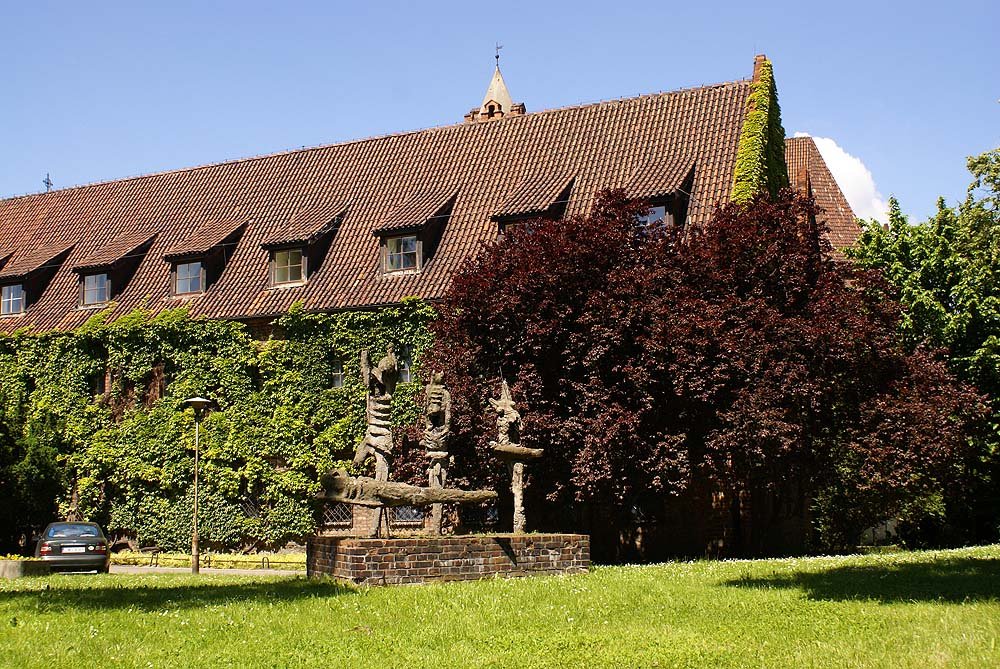
The building you see from plac Powstańców Warszawy was erected in 1883-1886 in the northern neo-Renaissance style to a design by Karl Friedrich Endell. The museum moved into it only after the Second World War: in 1946-1947, after it had been rebuilt from war damage, the building was adapted for museum use.
The museum was officially founded on 28 March 1947, and the first visitors entered what was then the State Museum (Muzeum Państwowe) on 13 July 1948. In 1950 it took the name Silesian Museum (Muzeum Śląskie), and in 1970 it was raised to the rank of a National Museum. Its Silesian profile has remained to this day: the collection is dominated by painting and sculpture, with particular emphasis on the art of the whole of Silesia.
At the end of 2021 “Gazeta Wrocławska” reported that from 2022 the museum would be an institution run by the Ministry of Culture.
Nearby
 Art
Museum of Architecture in Wroclaw, in a former Bernardine monastery
ul. Bernardyńska 7, 50-156 Wrocław
Museum of Architecture in Wroclaw: the only architecture museum in Poland, in a 15th-century Bernardine monastery. What to see, who it …
 History
Archdiocesan Museum in Wroclaw
Plac Katedralny 16, 50-329 Wrocław
Archdiocesan Museum in Wroclaw: a Ptolemaic-era mummy, a bell of 1300 and a Cranach in three historic buildings. What to see, who it suits, …
 Science
Natural History Museum in Wroclaw - blue whale skeleton, four exhibitions
ul. Sienkiewicza 21, 50-335 Wrocław
Natural History Museum in Wroclaw: a blue whale skeleton, 66 vertebrate skeletons, animals and plants. What you will see, who it suits, how …
Museum of Illusions Wroclaw - interactive exhibits on Wyspa Piasek
ul. Staromłyńska 4 (Wyspa Piasek), Wrocław
Museum of Illusions Wroclaw on Wyspa Piasek: 400 m2 of interactive exhibits, light drawing and an upside-down room. Who it suits, time …
House of Illusions Wroclaw (Market Square)
ul. Rynek 33, 50-102 Wrocław
House of Illusions Wroclaw at Rynek 33: a mirror maze, optical illusions, a ball pool and terrariums. Who it suits, how long to allow and …
Żyjnia (Lifery) BWA Wroclaw - a gallery and urban sanatorium on Świdnicka
ul. Świdnicka 2-4, 50-067 Wrocław
Żyjnia (Lifery) BWA Wroclaw: a contemporary art gallery and urban sanatorium on ul. Świdnicka. What you will see, who it suits and how to …