Hydropolis Centre for Ecological Education
Hydropolis - Centrum Edukacji Ekologicznej
1.9 km from the Market Square in Wroclaw See museums near the Market Square in Wroclaw
- Wheelchair: Yes
- English labels: The whole exhibition is translated into English, with exhibit descriptions and film subtitles.
- Payment: Tickets are sold online or at the ticket office, where you can pay in cash or by card.
- Exhibition maps are available in English, German, Russian, Ukrainian and Czech.
- The audio guide is a mobile app that you download to your smartphone.
- Entry is timed: at most 60 people go in per half-hour slot, and an online ticket lets you pick a free start time.
Location
What to expect
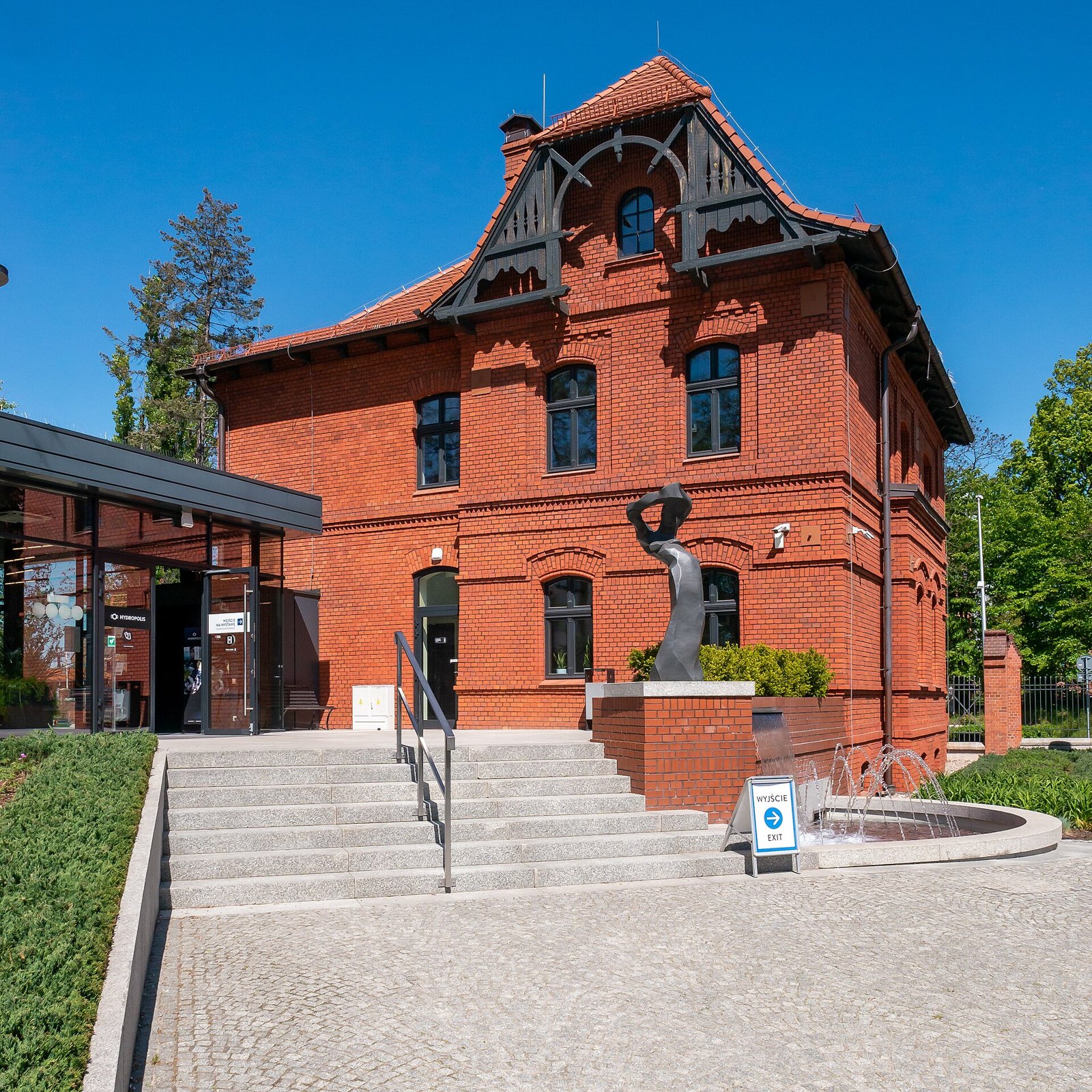
Hydropolis in Wroclaw is a multimedia exhibition about water, set up in a 19th-century neo-Gothic underground clean-water reservoir covering 4600 m². It is run by the Centre for Ecological Education, which the city’s water company opened here in 2015.
The visit begins with a ten-minute film about the origin of water on Earth, shown as a 360-degree projection on a 65-metre screen. You then walk through seven permanent thematic zones; there is also a children’s zone, a relaxation space and changing temporary exhibitions. Interactive games and multimedia await the youngest visitors.
A seasonal attraction is an installation the museum calls the longest water printer in Europe: in autumn 2026 the museum announced that it would go into winter sleep as temperatures fell. On Google Maps Hydropolis has 4.5 out of 5 from 10,180 reviews (read on 25 October 2026), and the 200 newest reviews read that day spanned about a month.
Who it is for: families with children from about six, schools, and adults who prefer learning through screens and tasks rather than display cases. It also works well for visitors from abroad, because the whole exhibition is translated into English, with exhibit descriptions and film subtitles.
Who should skip it: anyone looking for a classic museum with real specimens. They will do better at the Museum of Natural History in Wroclaw , whose four permanent exhibitions include 66 complete vertebrate skeletons and the skeleton of a blue whale.
How long: the museum advises allowing about two hours, and that is a good measure. The film itself takes ten minutes, and the seven zones and the children’s zone need the rest of the time, especially with children playing the games.
Tips
- Buy your ticket online with a start time. At most 60 people enter the exhibition in half-hour cycles. When you buy online you always choose a free start time; at the ticket office (cash or card) you may have to wait for your visit to begin.
- Cheaper on a weekday. The prices in the practical box (standard ticket 45 PLN (about 10 EUR), reduced 36 PLN (about 8 EUR)) apply on weekdays; at weekends, on public holidays and on special days tickets cost more. On weekdays the museum also has “Happy hours”: the last entry is cheaper.
- Family tickets and cards. The family ticket covers two adults and at most two children. The ticket for children under three is collected at the ticket office. Reduced ticket price: see the practical box; the museum’s price list gives all concessions and free visits. For frequent visitors the museum also sells an Annual Entry Card (Roczna Karta Wstępu).
- Quiet Sunday evenings. Every Sunday, for the last two hours before closing, quiet hours apply: the museum asks visitors to keep quiet and mute their phones. Visitors sensitive to stimuli can also borrow a sensory backpack with noise-cancelling headphones from the information point on the exhibition.
- In English and other languages. Besides the English descriptions, the museum has exhibition maps in English, German, Russian, Ukrainian and Czech, and the audio guide works as a smartphone app. Every zone also has one recording in Polish Sign Language.
- Photos yes, films no. Photos with a phone are allowed, but without flash. Filming is banned, especially during the screening in the Planet of Water zone (Strefa Planeta Wody), unless the museum gives permission.
- Cloakroom and food on site. The cloakroom is free and has lockable lockers, and there are two cafes at Hydropolis that also serve food. A full visit takes about two hours and the last entry is earlier than closing time (details in the practical box), so do not arrive late in the day.
- With a guide on Sunday. Every Sunday the museum runs a paid guided tour for individual visitors; the time and price are given in the museum’s price list. Every day you can also take a guided tour of the Eastern Boiler House (Kotłownia Wschodnia), part of the historic Water Tower (Wieża Ciśnień) complex on ul. Na Grobli, which tells the history of water in Wroclaw; groups book at rezerwacje@hydropolis.pl .
Getting there
- Address: ul. Na Grobli 17, 50-421 Wrocław. The museum describes its location as two tram stops from Galeria Dominikańska.
- Bus: the nearest stop, about 144 m in a straight line, is “Na Grobli (Hydropolis)”, where according to the timetable in the open data of Wroclaw City Hall only line 920 calls. Lines D, 145, 146 and 149 call at the “Urząd Wojewódzki (Impart)” stop, about 726 m in a straight line.
- Tram: trams 3, 5 and 16 stop at “Pl. Wróblewskiego”, about 644-670 m in a straight line, and tram 4 at “Urząd Wojewódzki (Impart)”, about 746-768 m in a straight line.
- Verdict on getting there: from the tram you have a longer walk than from bus 920, but the trams give you more lines to choose from; bus 920 is the only line with a stop within 400 m of the museum.
- On foot from the zoo: in summer you can cross a footbridge from the zoo side; the museum says it is a few minutes’ walk, and the crossing is open only in the summer season.
- By car: the car park on the Hydropolis grounds is for organised groups arriving by coach and for people with disabilities.
- Accessibility: the entrances are barrier-free, lifts serve all zones of the exhibition, the toilets are adapted, and a wheelchair can be borrowed on site.
Background
The interior in which you see the exhibition today was for decades part of the city waterworks, not a place for visitors. It is a 19th-century neo-Gothic underground clean-water reservoir; the Polish Wikipedia gives its area as 4600 m².
The English Wikipedia writes that the reservoir was entered in the register of monuments in 2002 and taken out of use in 2011. According to the Polish Wikipedia, Wroclaw’s municipal water and sewerage company (Miejskie Przedsiębiorstwo Wodociągów i Kanalizacji), after the necessary repairs and revitalisation, turned it into the Hydropolis Centre for Ecological Education in December 2015. Both encyclopaedias agree in dating the opening to 2015.
That is why the reservoir is not a backdrop here but the first exhibit: you see an exhibition about water inside a structure that stored that water for over a hundred years.