MNK Arsenal (Gallery of Ancient Art)
MNK Arsenał
389 m from Rynek Główny in Krakow See museums near Rynek Główny in Krakow
- Wheelchair: Yes
- Elevator: Yes
Location
What to expect

Two collections with nothing in common share this building: roughly a thousand pieces of old weaponry downstairs, the ancient art of the Mediterranean upstairs. Nobody comes to the MNK Arsenal in Krakow for one famous object, which is exactly why it stays quiet while a queue forms across Pijarska street for the Lady with an Ermine. If you have already done the Old Town’s headline sights and want an hour indoors without crowds, this is the answer.
The ground level holds Arms and Colours in Old Poland, open since 27 October 2023. Curator Michał Dziewulski built it around the 1683 relief of Vienna, then read that story through culture rather than combat. Most of the pieces never saw a battlefield, and the saddles are displayed as jewellery rather than as tack. The set piece everyone stops at is a reconstructed hussar procession with four horses.
A 10th-century helmet and sword open the display, and about seventy Persian and Turkish objects get a section of their own, shown together for the first time. Small drawers beside the cases are yours to open.
Upstairs is the Zrodla Gallery of Ancient Art, curated by Dorota Gorzelany-Nowak. It runs from Egypt, Greece, Italy and Asia Minor - the beginnings of civilisation to the Roman period - and adds Polish prehistory plus a selection of Greek and Roman coins. The pieces that stay with you are individual ones - the mummy cartonnage of Asetemachbit from the 9th century BC, gold spiral earrings from southern Italy of the 4th century BC, Roman portrait sculpture.
Children head straight for the sarcophagi and the cat mummies.
Best for anyone interested in the material culture of the old Polish-Lithuanian Commonwealth, and for visitors who prefer objects to screens. This is cases, drawers and labels - it makes no attempt to be an interactive museum. If you have two days in Krakow and have not yet seen the Leonardo, start on the other side of the street instead.
Tips
- Allow an hour. That covers both galleries at a normal pace. Add half an hour if you read militaria labels properly; nobody spends an afternoon here.
- Pupils and students pay 1 PLN. A standard ticket is 18 PLN, reduced 14 PLN, a family ticket 36 PLN. The audio guide is 10 PLN - ten times the student ticket, so do the arithmetic before you reach the desk.
- Free on Tuesday, and that means everything. Free admission covers the permanent exhibitions, and both galleries here are permanent. Tuesday is also the busiest day; for quiet, come on a Thursday just after 10:00. Monday is closed.
- Audio guide in eight languages. Polish, English, French, German, Italian, Ukrainian, Russian and Spanish, plus a sign-language version, audio description and a family track. The museum does not publish which languages the case labels use, so the guide is the safer bet if you read no Polish.
- There is a lift, whatever the guidebooks say. Family guides circulating online still describe stairs at the entrance and no lift; that was the building before the 2017-2021 works. The museum now lists an entrance with a small threshold and a ramp, a lift from level -1 to the first floor, an accessible restroom, wheelchairs and folding seats to borrow, and a sensory basket in the Cabinet of Prehistoric Archaeology.
- The Czartoryski Museum is a separate ticket. The building opposite belongs to the same historic foundation but is a different branch with its own desk. The Arsenal is not a continuation of that route, so budget two admissions if you want both.
- No booking needed. There is no timed entry; buy at the door or in advance at bilety.mnk.pl.
- A guided tour only pays for a group. 170 PLN plus admission in Polish, 220 PLN plus admission in another language.
Getting there
On foot: from the Main Market Square walk up Floriańska to St Florian’s Gate, then left into Pijarska - under ten minutes. From the main railway station and the Galeria Krakowska shopping centre it is a similar walk along the edge of the Planty park.
Tram: stop Stary Kleparz, lines 4, 14, 18, 20 and 52, then five minutes on foot along the Planty towards St Florian’s Gate.
Bus: lines 124, 152 and 424, the same Stary Kleparz stop.
By car: Pijarska sits inside the paid parking zone at the edge of the Old Town and the museum has no car park of its own. Designated accessible parking spaces are marked nearby.
Nearby
The Czartoryski Museum is directly opposite and part of the same block of buildings. The choice is simple: one Leonardo masterpiece and a queue there, two galleries and room in front of the cases here.
The Czartoryski Library on św. Marka street completes the princely foundation - a third address of the same family within three hundred metres.
The Barbican is two minutes north and the obvious sequel to the militaria gallery: after the weapons in their cases you stand in the fortress they were carried to defend. Both sit on one walk along the northern stretch of the city walls.
Background
The city builder Gabriel Słoński put up the original structure in 1565-1566: a single-storey arms and gunpowder store of broken sandstone, wedged between the towers of the city wall. In the early 19th century it was slated to go down with the walls. It survived through the intervention of senator Feliks Radwański, the man Krakow also has to thank for the fortifications still standing at St Florian’s Gate.
Antoni Stacherski added the upper floor between 1854 and 1861 and gave the building the look of an early Italian Renaissance castle. In 1874 the city handed the arsenal and the adjoining towers to Prince Władysław Czartoryski for museum use. Maurycy Ouradou then tied it to the Klasztorek and the neighbouring houses into a single complex. The Klasztorek opened in 1876 and became the beginning of the Czartoryski Museum.
The Czartoryski Library sat here until 1961. The building was heritage-listed on 18 January 1932, and the interiors you walk through are the result of renovations in 2014-2016 and 2017-2021.
Nearby museums
 Art
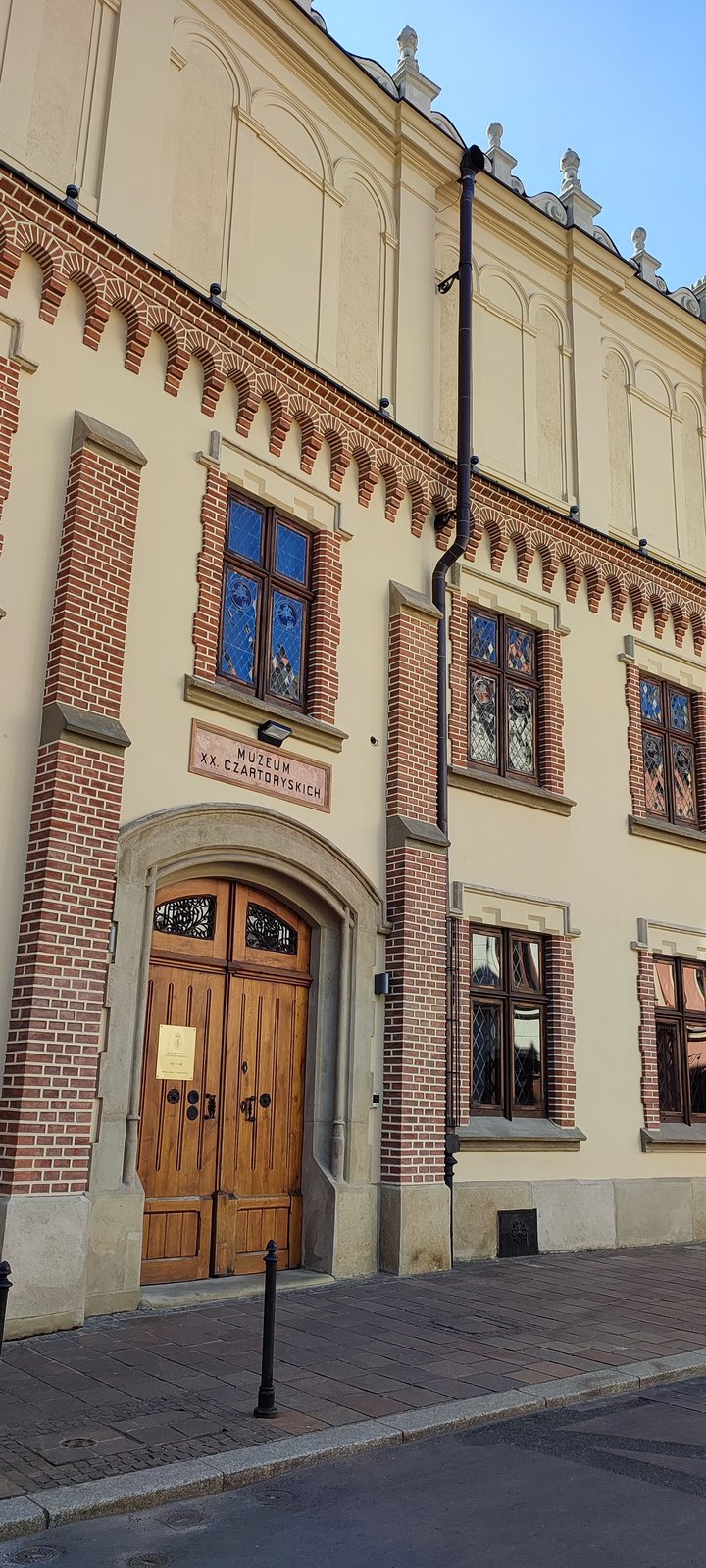
ArtCzartoryski Museum
ul. Pijarska 15, 31-015 Kraków
Czartoryski Museum in Krakow - Leonardo's Lady with an Ermine. Open Tue-Sun 10:00-18:00, tickets 65/50 PLN, free entry on Tuesdays.
 Art
Closed
Art
ClosedPrinces Czartoryski Library
ul. św. Marka 17, 31-018 Kraków
The Princes Czartoryski Library in Krakow - the National Museum's research library of 231,000+ volumes. Closed for expansion; reopens in …
 History
Barbican
ul. Basztowa 1, 30-547 Kraków
The Krakow Barbican - a Gothic fortress of 1498-1499 on the Royal Route, a Museum of Krakow branch. Open 10 May to 30 October, Tue-Sun, …