Intangible Heritage Interpretation Centre of Krakow
Centrum Interpretacji Niematerialnego Dziedzictwa Krakowa
539 m from Rynek Główny in Krakow See museums near Rynek Główny in Krakow
Location
What to expect
This is the only branch of the Museum of Krakow with no permanent exhibition, and the only one whose subject cannot be put in a case. It works on customs, crafts and sounds - the things residents hand on to each other rather than deposit in a store room. Two of them you may already have met on the street. The Lajkonik is a bearded rider in pseudo-Tatar costume on a hobby horse. He parades from the Zwierzyniec district to the Main Market Square in the octave of Corpus Christi, tapping bystanders with his mace for luck. The procession has been on Poland’s national intangible heritage list since 2014. The szopka krakowska is an ornate nativity scene built as a miniature of Krakow’s towers and domes in coloured foil. It is judged every first Thursday of December on the steps of the Adam Mickiewicz monument, and in 2018 it became Poland’s first entry on the UNESCO Representative List. Szpitalna 21 is the office behind both.
What that means for your visit: you are buying a ticket to whatever temporary exhibition is running, plus a programme of workshops, sound walks and meetings with the people who keep these traditions going. Check what is on before you commit an hour to it.
Until 11 October 2026 the branch showed “Krakow. Sounds, Melodies, Words”, curated by Monika Widzicka - an exhibition to listen to more than to look at, built around a sound installation by Marcin Dymiter, with the old clapper of the Zygmunt bell, on loan from Wawel Cathedral, as its strongest exhibit. The show has now closed; the branch’s current programme is on the Museum of Krakow events page .
Best for a second or third trip to Krakow, or for a rainy hour once the headline sights are done. On a first two-day visit, it is too narrow a subject to earn the slot. And if what you actually want is folk culture in object form - costumes, interiors, cabinets - the Ethnographic Museum in Kazimierz covers the same traditions the other way round.
Tips
- Check the current exhibition before you buy. With no permanent display, the whole value of the visit rides on the temporary show. If its subject does not appeal, skip this address - 26 PLN for an hour is a considered choice, not a default stop.
- Wednesday, not Tuesday. The museum publishes Wednesday to Sunday, 10:00-17:00. Several tourism portals repeat “Tuesday to Sunday”, which is wrong; the doors are shut on Mondays and Tuesdays.
- Last entry is 16:30. Thirty minutes before closing for individuals, 60 minutes for groups. On an audio-led show, arriving in the final quarter of an hour is pointless. Allow 45 to 60 minutes, or 75 if you intend to hear every track.
- Prices, and no free day. Standard 26 PLN, reduced 22 PLN, family 52 PLN. Groups of 10 or more pay 16 PLN per person, school groups 11 PLN. A guided tour is 150 PLN on top of tickets and must be booked ahead by phone or email. Unlike several other Museum of Krakow branches, this one publishes no free-admission day - spend your free days on the neighbours and pay to get in here.
- English on site: assume some, verify on arrival. The city tourism portal describes the current exhibition as bilingual Polish and English, but the museum itself does not state the label language. The audio is the point here and much of it is the city rather than speech, so the language barrier is lower than at a text-heavy branch.
- Children work here only in the guided format. The museum runs tours for ages 6 to 12 with a worksheet and listening riddles; places are limited and must be booked online. Without that, it is a few rooms of quiet listening and a young child will be finished in ten minutes.
- The nativity scenes are not here. This branch runs the contest and looks after the collection, but the szopki are displayed at Krzysztofory Palace , three minutes away. Come for the programme, not for the cribs.
- Glance at the branch page before you travel. The museum has funding to modernise the House under the Cross and has not published a works schedule. The building dates from the 15th century and the museum states there is no lift: a high threshold at the Szpitalna entrance (staff can lay a portable ramp on request), only the ground floor is step-free and stairs lead to the upper floors - if step-free access matters, call +48 12 422 52 58 first.
Getting there
On foot: three minutes from the Main Market Square. Take Św. Jana or Floriańska towards the Planty park ring, then turn right into Szpitalna. The House under the Cross faces the Słowacki Theatre.
Tram: the Teatr Słowackiego stop is at the end of Szpitalna on plac Świętego Ducha; Stary Kleparz is the next option to the north.
From the station: about ten minutes on foot from Kraków Główny and the Galeria Krakowska mall, across the Planty - which makes this an easy first or last stop on a day in the centre.
By car: this corner of the Old Town is a restricted traffic and paid parking zone. Leave the car near the station and walk.
Nearby
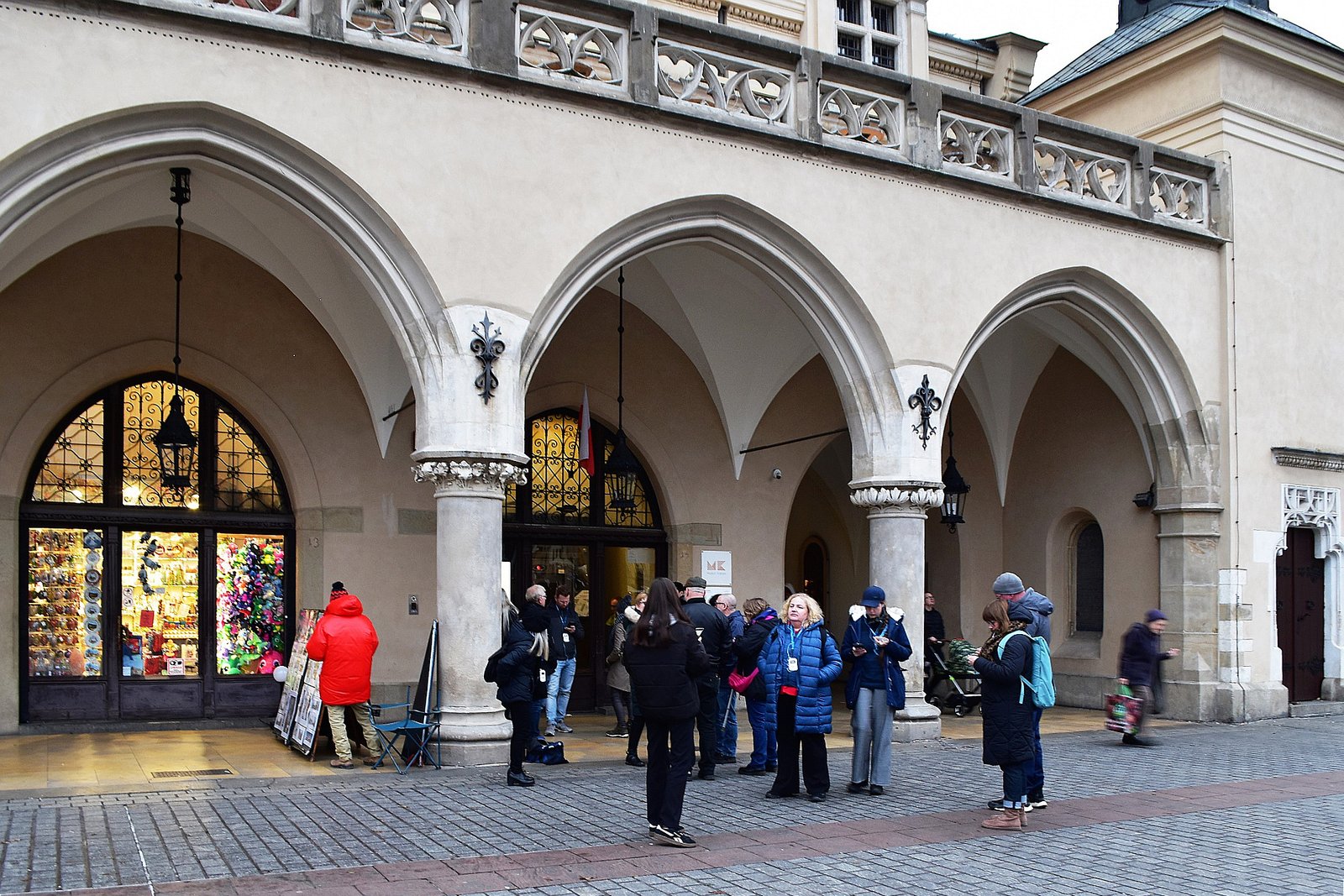
Three minutes towards the square, Krzysztofory Palace tells the city’s history and displays the nativity scene collection this branch curates. Under the square itself, the Rynek Underground is the museum’s opposite extreme: a multimedia archaeological route that needs advance booking in high season, where Szpitalna takes walk-ins all day. In the Cloth Hall, the Sukiennice Gallery of 19th-Century Polish Art hangs the national painting canon upstairs.
Background
The House under the Cross is one of the oldest buildings on Szpitalna. It was raised for the hospital of St Roch, which cared for poor scholars, rebuilt between 1458 and 1460, completed in 1474, and given a Renaissance wing in 1594. From 1790 it belonged to St Mary’s parish, which ran a poorhouse here and hung the crucifix on the facade that gave the house its name.
The city bought it in 1903. An artists’ association held the first floor from 1917 to 1937, and in the spring of 1933 Józef Jarema opened the experimental Cricot theatre in the building. The museum took it over after 1949, conservation ran from 1958 to 1969, and in 1969 it reopened as the theatre division dedicated to Stanisław Wyspiański. That display closed in 2008 and never returned. The Intangible Heritage Centre took the building in 2020, with the team based at Szpitalna since March 2021.
Nearby museums
 History
Krzysztofory Palace - Museum of Krakow
Rynek Główny 35, 31-011 Kraków
Krzysztofory Palace on the Main Square - main seat of the Museum of Krakow and its city-history exhibition. Hours, tickets 34 PLN, free on …
 History
Rynek Underground
Rynek Główny 1, 31-042 Kraków
Rynek Underground Krakow - archaeological route beneath the Main Square. Opening hours, tickets 45/35 PLN, free Tuesdays, booking advice.
 Art
ArtSukiennice - Gallery of 19th-Century Polish Art
Rynek Główny 3, 31-042 Kraków
Sukiennice Gallery of 19th-century Polish art above Krakow's Cloth Hall. Open Tue-Sun 10:00-18:00, tickets 35/25 PLN, free on Tuesdays.