Museum of Dollhouses, Games and Toys
Muzeum Domków Lalek, Gier i Zabawek
- Wheelchair: Yes
- Stroller: No
- Elevator: Yes
- Recommended age: 5+
- Stroller access: No
Location
Smaller than your apartment, more interesting than most galleries. The Museum of Dollhouses is housed in Pałac Bazylianów in Warsaw’s Old Town - entry through the gate marked FRYDERYK at ul. Podwale 15. Four permanent exhibitions and one temporary, all in a single location. Plan for about 1.5 hours.
What to expect
The museum operates from a single location - in the historic walls of Pałac Bazylianów, right by the heart of the Old Town. Four permanent exhibitions present a unique collection of toys, dolls and miniatures from different eras and corners of the world, plus one temporary exhibition.
W świecie dawnych domków dla lalek (In the world of antique dollhouses)
Over 200 meticulously furnished houses, shops, schools and hospitals, with the oldest pieces dating back to the 18th century. This is not a toy collection - these are micro-worlds recreated with watchmaker precision.
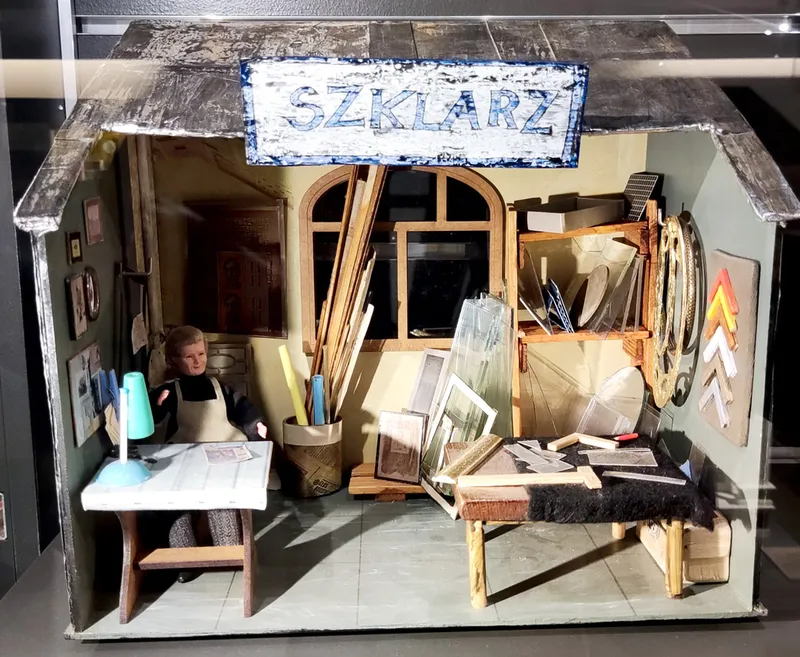
The first thing that catches your eye is the artisan workshops. A miniature glazier’s studio with bundles of glass, brushes, and half-finished pieces; an upholsterer’s workshop with rolls of fabric and cushions at 1:12 scale; a painter’s atelier with an easel, palette, and open tubes of paint. Every detail - from shoes on the floor to newspapers on the table - is handcrafted.
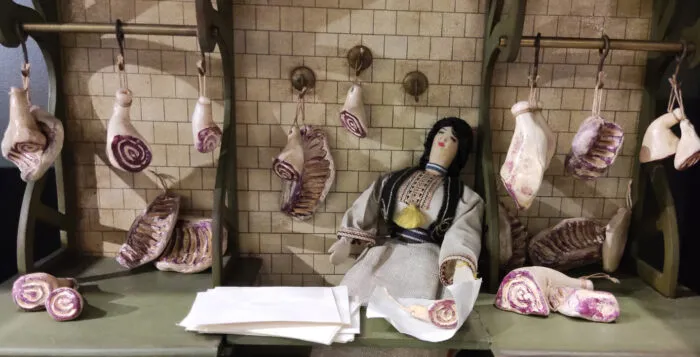
Further in, multi-storey building replicas. A pharmacy with rows of tiny jars on shelves, a butcher shop with sausages and ham behind glass, an English seaside scene with striped bathing huts and miniature deckchairs. Some houses have illuminated interiors, adding remarkable depth.
A special place is given to a model English house built by a Polish pilot from RAF 304 Squadron - one of the Polish bomber squadrons stationed in Britain during World War II. The squadron flew Wellington and later Warwick bombers on anti-submarine and convoy escort missions over the Atlantic and North Sea. The house was likely built during downtime between missions, as an expression of longing for normality. There is also a 50-year-old Playmobil figurine (one of the earliest series) and a German gymnasium model from the 1940s with Nazi propaganda elements - jarring but historically significant.
School-style models (open-fronted houses with swappable furniture) are particularly popular with younger visitors.
Zabawki sakralne (Sacred toys)
An unusual collection of religious-themed toys, predominantly Christian, with references to other faiths. Miniature monastic cells, altars, chapels, convent schools, and dolls in liturgical and religious robes.
The centrepiece is a 200-year-old neo-Gothic miniature altar - precisely carved, with gilding and figurines of saints. Surrounding it are miniature chapels and churches with full liturgical furnishings, dolls depicting nuns in habits and priests in vestments.
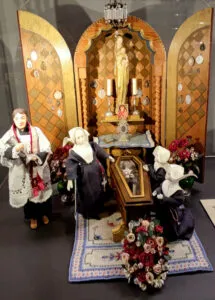
The most memorable piece is a funeral scene: a doll in a glass-topped coffin surrounded by kneeling nuns and a priest holding a chalice. Macabre? Not exactly - it is rather a testament to how toys once served to familiarise children with topics we now consider difficult. Worth seeing regardless of your faith.
Lalki świata (Dolls of the world)
Over a thousand dolls in traditional dress from five continents. The exhibition shows the richness and significance of ethnic costume - from Japanese kimonos to Peruvian shawls, from Scandinavian folk wear to African tribal ornaments. Fabric details, embroidery and accessories are faithfully reproduced, often in collaboration with ethnographic museums in the countries of origin.
Polskie gry i zabawki XX wieku (Polish 20th-century games and toys)
Icons of Polish design, from artisan craftwork to cult products of the Polish toy industry. Over 1,000 toys from communist-era Poland (1950s-1970s): state-factory dollhouse furniture, tin robots, plastic kitchen sets, and the iconic “Młody Fryzjer” (Young Hairdresser) and “Młody Lekarz” (Young Doctor) play kits that generations of Poles remember.
For anyone who grew up behind the Iron Curtain or heard their parents’ stories - guaranteed nostalgia. For younger visitors, it offers a window into the everyday life of an era whose traces are rapidly disappearing.
Chopin - Inne spojrzenie (Chopin - A Different Perspective; temporary + online)
Contemporary interpretations of Fryderyk Chopin in the form of portrait art dolls. Each doll is a different, sensitively crafted story about Chopin - about his music, emotions, and spiritual heritage that still moves successive generations. The exhibition is also available online.
Tips
- Visit time: Plan for about 1.5 hours. With four permanent exhibitions plus the Chopin temporary - dollhouses, sacred toys, dolls of the world, Polish 20th-century toys - 30 minutes won’t cut it.
- Don’t miss: The glazier’s workshop in the dollhouse exhibition - the level of detail is staggering. Worth leaning in for a close look.
- Kids: Suitable from age 5. No interactive exhibits - this is a look-but-don’t-touch museum. Younger children will get bored quickly.
- Adults too: Despite appearances, this is not just a children’s museum. The craftsmanship, historical context, and sacred collection are genuinely fascinating for adults.
- Finding the entrance: Enter through the gate marked FRYDERYK at ul. Podwale 15. The gate leads to the courtyard of Pałac Bazylianów.
- Tickets: Standard ticket 42 PLN (~10 EUR), reduced 30 PLN (~7 EUR) for children, students under 26, and seniors 60+. Family tickets available. Children under 100 cm enter free.
- Photography: Allowed without flash. Bring a charged phone - there is a lot to photograph.
- Shop: The museum has a gift shop with souvenirs, toys and collectible miniatures.
- Accessibility: the museum is largely accessible to wheelchair users - entry to the exhibition is possible on weekdays 9:00-17:00 after a phone call (797 723 029), when staff operate a ramp and lift bridging a four-step level change. Prams, however, are not allowed into the exhibition and must be left in the entrance hall.
Getting there
Public transport: Trams 4, 6, 13, 20, 23 - Stare Miasto stop. Buses 116, 178, 180, 503, 518 - Kapitulna stop.
On foot: 5 minutes from Castle Square (plac Zamkowy), in the heart of the Old Town. Combines perfectly with a visit to the Royal Castle and a stroll through the Old Town streets.
In the neighbourhood
- Tiger Score - Interactive Pinball and Video Game Museum - ul. Podwale 17, about 50 m. A private collection of more than 70 pinball machines and video arcade games from the 1930s to the present day; the machines are switched on and playing them is what your ticket buys.
- Museum of Pharmacy - ul. Piwna 31/33, about 150 m. A branch of the Museum of Warsaw in the house once home to the architect Tylman van Gameren; the first room reconstructs an interwar pharmacy from Wołomin.
- Leather Craft Guild Museum - ul. Wąski Dunaj 10, about 150 m. The early 16th-century Shoemakers’ House, home of the guild for over 400 years; two rooms hold a complete 19th-century shoemaker’s workshop and a saddler’s workshop.
Nearby museums
 History
The Royal Castle in Warsaw
plac Zamkowy 4, 00-277 Warszawa
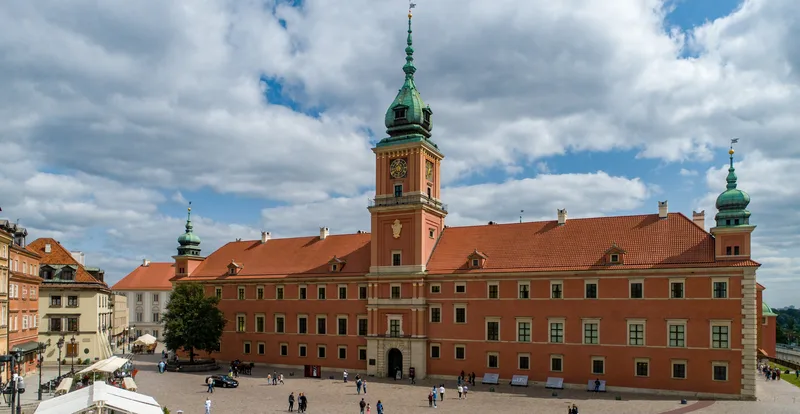
The Royal Castle in Warsaw - one of the most important landmarks of the Polish capital. Practical info, opening hours, tickets, getting …
 History
Museum of Warsaw
Rynek Starego Miasta 28-42, 00-272 Warszawa
Museum of Warsaw on the Old Town Market Square - 7,000 objects in 11 historic townhouses. Opening hours, tickets, how to get there, …